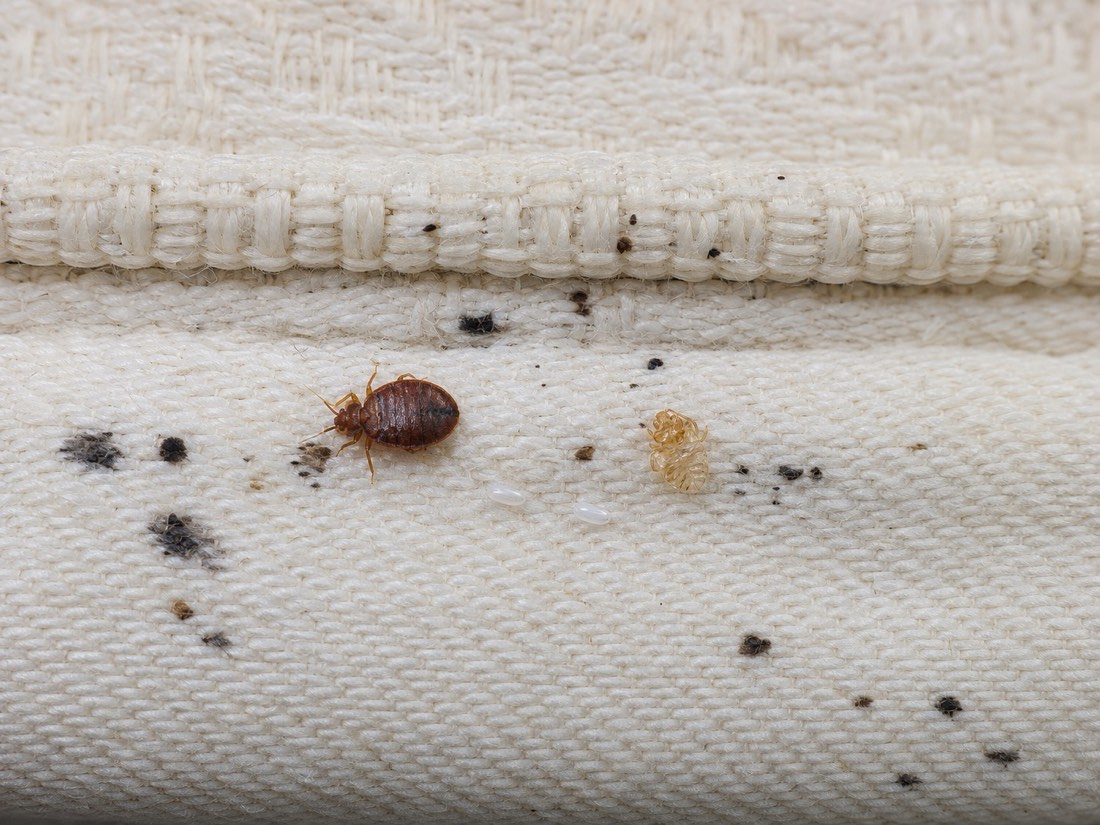
- An isolated pale speck is weak evidence without location and accompanying signs.
- Eggs are more likely in protected hiding places than on exposed surfaces.
- A treatment plan must allow for hidden life stages and follow-up.
- Eggs are pearly white, about 1mm long and glued into cracks and crevices.
What do bed bug eggs look like?
Bed bug eggs are pearly white and about 1mm long. Northumberland County Council gives that size and colour. At 1mm, they are easy to miss without a magnifier.
So that is the short answer to “are bed bug eggs visible”. Yes, if you look closely and the light is good. However, they are easy to miss. We have no photographs on this page, so the sections below describe each feature in words.
| Feature | What sources say |
|---|---|
| Size | About 1mm long (Northumberland County Council). |
| Colour | Pearly white (Northumberland County Council). |
| Surface | Glued into place by the female, so they stick to surfaces (Northumberland County Council). |
| Where laid | Glued into cracks and crevices in bed frames, furniture and wallpaper (Northumberland County Council). |
| Hatching | Usually within 10 to 20 days (Northumberland County Council, Redbridge Council). |
Note that the sources we checked do not describe the egg shell texture, so we cannot say if eggs feel hard or soft. We also cannot give a reliable colour for old or dead eggs.
Why photographs of eggs are misleadingly simple
Search results often show a sharply enlarged egg on a clean background. A real inspection looks very different. The egg is tiny, the light is poor and the crevice is full of fibres and dust. Because of this, you need more than a magnified picture to identify it.
Our guide to identifying bed bugs explains why a single sign is never enough. Eggs are only one piece of the picture, so read it alongside this page.
Use location as part of the evidence
Because bugs prefer shelter, protected seams, screw holes, headboard joints and furniture gaps close to a bed deserve attention. For example, several fixed objects beside dark spotting in a bed-frame joint tell you far more than a pale speck on an exposed windowsill. The guide to where bed bugs hide lists the places to check first.
Do not scrape every object away before you record it, because you may destroy the evidence. Take a close photograph, then a wider one that shows the location. If you can, lift a sample with clear tape or a suitable container without destroying it.
Where bed bugs lay eggs
Northumberland County Council says females glue eggs into cracks and crevices in bed frames, furniture and wallpaper, and anywhere that gives dark shelter in the day. The Natural History Museum says they lay eggs in crevices and behind wallpaper, after feeding and mating.
As a result, most home infestations are in bedrooms, near where people sleep, according to the same council. So start with the bed frame, the mattress seams and the headboard.
Eggs, eggshells and hatching
In total, a female lays roughly 150 eggs in her lifetime, according to Northumberland County Council. The Natural History Museum gives a similar figure of around 150.
Eggs usually hatch after about 10 to 20 days, says Redbridge Council, and Northumberland County Council gives the same range. Redbridge also warns that eggs keep hatching after a treatment has been carried out, which is why follow-up matters.
You may also find empty egg cases. Treat them like a whole egg, and photograph them.
Bed bug eggs compared with look-alikes
However, many small pale things turn up near beds. Only some of these comparisons have a source, so the table says which.
| Could it be… | How it differs | Source |
|---|---|---|
| Flea eggs | Flea eggs are 0.5mm long, pearly white, oval and slightly sticky. That is about half the size of a bed bug egg. | Northumberland County Council |
| Cockroach eggs | Cockroach eggs are the size and shape of a small kidney bean and brown. They are far bigger than a bed bug egg. | Northumberland County Council |
| Silverfish | Silverfish are small and white when young but soon turn brown. They lay eggs in crevices or cracks. | Northumberland County Council |
| Lint or dust | We have no source for this. A practical test: eggs are stuck in place, so a speck that brushes off freely is less likely to be an egg. | Reasoning from the sticky egg description above |
Of these, flea eggs are the closest match in colour. If you have pets, see how bed bugs differ from fleas.
How to check for eggs safely
For a safe check, use a bright torch and a magnifier, such as a phone camera zoomed in. While you check, work slowly along the seams of the mattress, the joints of the bed frame and the back of the headboard. Northumberland County Council advises looking behind the headboard and mattress for signs, and for tiny blood droplets on sheets and mattresses.
If you strip the bed, carry the bedding in a sealed bag. Our check your bed guide gives a full routine.
Eggs and the wider life cycle
Eggs are one stage in a longer cycle, and the stages overlap, so inspection must allow for that. Our guide to the bed bug life cycle explains how that affects inspection. Skin marks are a separate matter, so see bed bug bites if you have symptoms.
Eggs and treatment expectations
Hidden eggs are one reason a treatment plan should explain follow-up. A casual surface spray cannot promise success.
So the key questions are simple.
How will the provider reach hiding places? Does the price include monitoring? When will they check the property again? If the first visit fails, read why treatment sometimes does not work.
Heat, authorised insecticidal products and physical controls each have a role and limits. The right method depends on the property, your belongings and how much evidence you have. Do not turn general online advice into a product dose or plan. The HSE says people who use biocides are responsible for using them correctly, and that products must suit their purpose and follow the label.
If you find only an uncertain speck
Continue the inspection through the most likely hiding places and look for a pattern. Do not apply chemical treatment because one piece of lint resembles a photograph. A preserved sample or a professional inspection is a better next step than whole-room treatment.
Our advice on what to do first sets out a calm order of action. If eggs turn up after you buy a used sofa or bed, see the guide to second-hand furniture. To check your own council, see bed bug help in Bristol, council pest control in Liverpool, or council pest control in Brighton and Hove.
What to do if you think you have found eggs
- Photograph the speck close up, and then from further away to show where it is.
- Look for stronger evidence nearby. The NHS lists spots of blood on bedding and small brown spots on bedding or furniture. Adults are around 5mm long and dark yellow, red or brown.
- Do not start spraying. The NHS says it is very difficult to get rid of bed bugs yourself and that they may resist some insecticides.
- Wash bedding and clothing at 60C. The NHS also suggests freezing items that cannot be washed for 2 to 3 weeks.
- Contact your local council or a pest control company for identification.
This site is an independent guide, and it does not treat homes itself. If you want help, you can ask us to pass your enquiry on. We send it to a UK pest control company that covers your area, and we may receive a fee for doing so. The company is an independent business.
Questions people also ask
Can you see bed bug eggs without magnification?
You may see them, but their small size and pale colour make confident identification difficult. Good lighting and magnification help, and the surrounding evidence still matters.
Will vacuuming remove every egg?
No. A single pass cannot reach every protected crevice. Vacuuming can support a wider plan, but it is not complete eradication.
What do bed bug eggs look like?
Northumberland County Council describes them as pearly white and about 1mm long. They are glued into cracks and crevices, so they are easy to miss.
Are bed bug eggs visible?
Sometimes, but not easily. They are pearly white and only about 1mm long, so a torch and a magnifier help.
Are bed bug eggs hard or soft, and are they sticky?
Northumberland County Council says the female glues eggs into cracks and crevices, so they stay fixed in place. None of our sources describes how hard the shell is.
How long do bed bug eggs take to hatch?
Northumberland County Council and Redbridge Council both say eggs usually hatch within 10 to 20 days.
Sources and review notes
This page is written by the BedbugExtermination.co.uk editorial team. It has not yet been reviewed by an independently named pest-control professional. Health and pesticide statements are kept within the scope of the official sources below.
- Bedbugs
NHS - Identifying your pest
Northumberland County Council - Bed bug (Cimex lectularius) identification guide
Natural History Museum - Pest control: bed bugs
London Borough of Redbridge