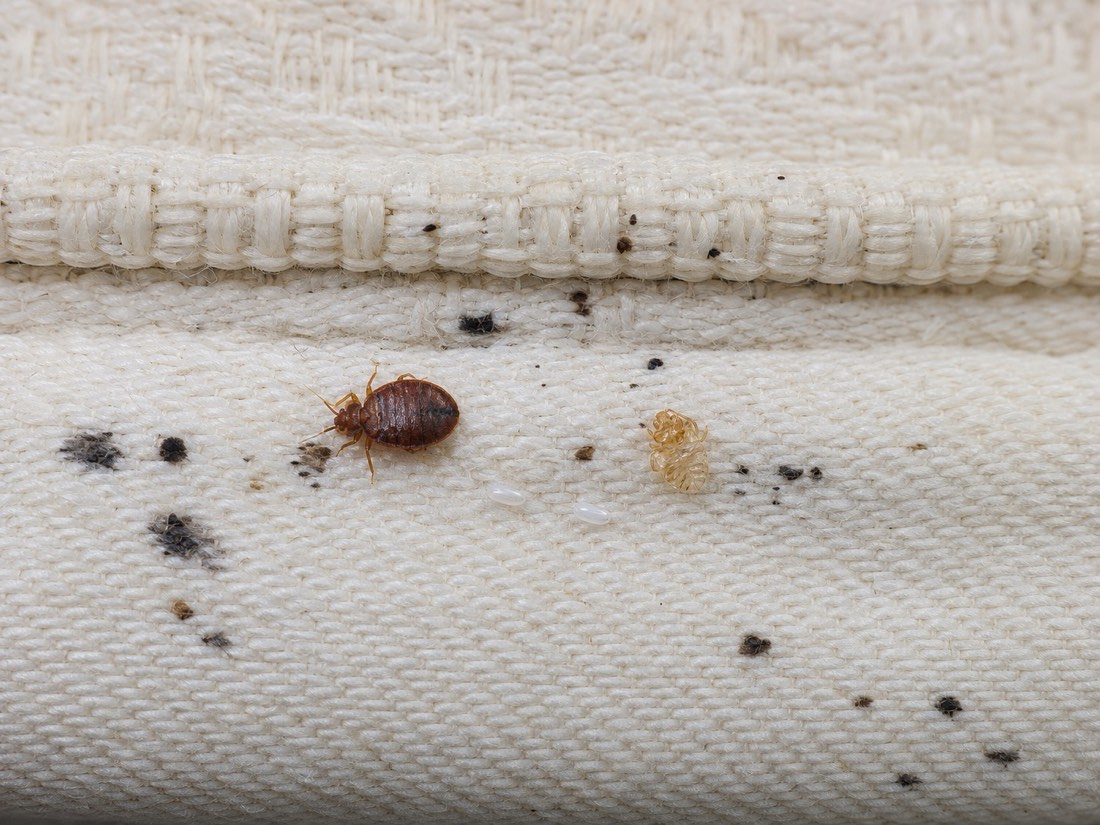
- Bed bugs have three phases: egg, five nymph stages and adult.
- Eggs usually hatch in 10 to 20 days.
- Young bed bugs need blood to develop through each stage.
- Development is slower in the cold, and eggs keep hatching, so follow-up checks matter.
The three phases of a bed bug’s life
A bed bug passes through three phases. It begins as an egg, grows through five immature stages (nymphs) and then becomes an adult. The Natural History Museum describes the same five immature stages.
Knowing the cycle helps you in practice because it explains why a single check can miss problems, why treatment often needs a follow-up and why one bite pattern does not tell the whole story.
Young bugs are smaller than the adults, so early signs are easy to miss.
Stage one: the egg
Female bed bugs lay eggs after feeding and mating. The Natural History Museum says they lay them in crevices and behind wallpaper. Northumberland County Council describes the eggs as pearly white, about 1mm long, and glued into cracks and crevices, so they stay where the female puts them.
A female lays roughly 150 eggs over her lifetime, according to both the Natural History Museum and Northumberland County Council. That is enough for a small group to grow quickly.
Eggs usually hatch after about 10 to 20 days, says Redbridge Council, and Northumberland County Council gives the same range. For a closer look, see our guide to what bed bug eggs look like.
Stage two: five nymph stages
A newly hatched bed bug is a nymph. The Natural History Museum says immature bed bugs have the same overall shape as adults but are smaller, and start off nearly colourless before turning browner as they mature. It grows through five stages, shedding its skin at the end of each one. This shedding is called moulting.
The key rule is simple. Redbridge Council says young bed bugs need to feed on blood to develop further at each stage. A nymph must feed before it can grow, which means every young bed bug is a biter.
The cast-off skins stay behind in hiding places, and they can look like the bugs themselves, so they are a useful clue. Our guide to where bed bugs hide explains where to look for them.
Stage three: the adult
Once a bed bug has gone through its fifth moult, it is an adult. Northumberland County Council says they reach adulthood in approximately nine weeks under reasonable conditions, and that development takes longer in cold conditions. Redbridge Council gives a wider range of about 9 to 18 weeks.
Adults can live a long time. For example, Northumberland County Council says they can live for up to 18 months. Adult bed bugs are around 5mm long and dark yellow, red or brown, according to the NHS.
How feeding and temperature change the timing
Bed bugs hide by day and become active at night, since they feed on sleepers. The Natural History Museum says they are mainly nocturnal and reach peak activity before dawn. Northumberland County Council says adults usually feed weekly.
They can also go without food for a very long time. The Natural History Museum says they can last a year or more without feeding. Redbridge Council says they can lie dormant and survive for six months between feeds. Our guide on how long bed bugs can live without feeding goes into this.
This is why an empty room is not always a clear room, because bugs can wait for a sleeper to return. Since development is slower in the cold, a warm bedroom is likely to see a faster build-up than a cold spare room.
Why the stages overlap
In a real infestation, you rarely see one stage on its own. Eggs, nymphs of different sizes and adults can share the same hiding place. As a result, a single treatment that reaches only some stages may leave others behind.
Overlap also explains why numbers can seem to jump. Since eggs take 10 to 20 days to hatch (Redbridge Council), new nymphs keep appearing for a while. A careful follow-up check, a week or two later, is therefore a sensible habit rather than a sign of failure.
What the cycle means for you
First, check often and check in the right places. Look at the seams and joints of the bed, because that is where bugs and eggs gather. Our check your bed guide gives a simple routine.
Second, do not rely on bites alone, because reactions vary from person to person, and other insects cause bites too. Read about bed bug bites and about bed bugs versus fleas to avoid mistakes.
Third, plan for a follow-up. Because eggs keep hatching after treatment (Redbridge Council) and nymphs keep growing, one treatment visit may not be the end. The NHS notes that professional pest control is recommended, since bed bugs can be hard to find and may resist some insecticides. If treatment seems to fail, see our page on when treatment is not working.
Where to get help locally
Some councils offer pest control for bed bugs, so rules differ by area. See what we say about council pest control in Edinburgh, Sheffield, and Newcastle upon Tyne. Our identify bed bugs hub links every identification guide.
If you want help finding a professional, use our request help form. We are an information and referral site, so we do not treat homes ourselves.
Questions people also ask
How long does it take a bed bug to become an adult?
Northumberland County Council says about nine weeks under reasonable conditions, and longer in the cold. Redbridge Council gives about 9 to 18 weeks.
How many eggs does a female lay?
Roughly 150 eggs over her lifetime, according to Northumberland County Council and the Natural History Museum.
Do nymphs bite?
Yes. Nymphs are young bed bugs and they feed on blood. Each stage needs a meal before it can moult into the next one.
Can bed bugs live without feeding?
For a long time. The Natural History Museum says they can last a year or more without feeding. Redbridge Council says they can survive about six months between feeds. See our guide on how long bed bugs live without feeding.
Sources and review notes
This page is written by the BedbugExtermination.co.uk editorial team. It has not yet been reviewed by an independently named pest-control professional. Health and pesticide statements are kept within the scope of the official sources below.
- Bed bug (Cimex lectularius) identification guide
Natural History Museum - Pest control: bed bugs
London Borough of Redbridge - Identifying your pest
Northumberland County Council - Bedbugs
NHS